
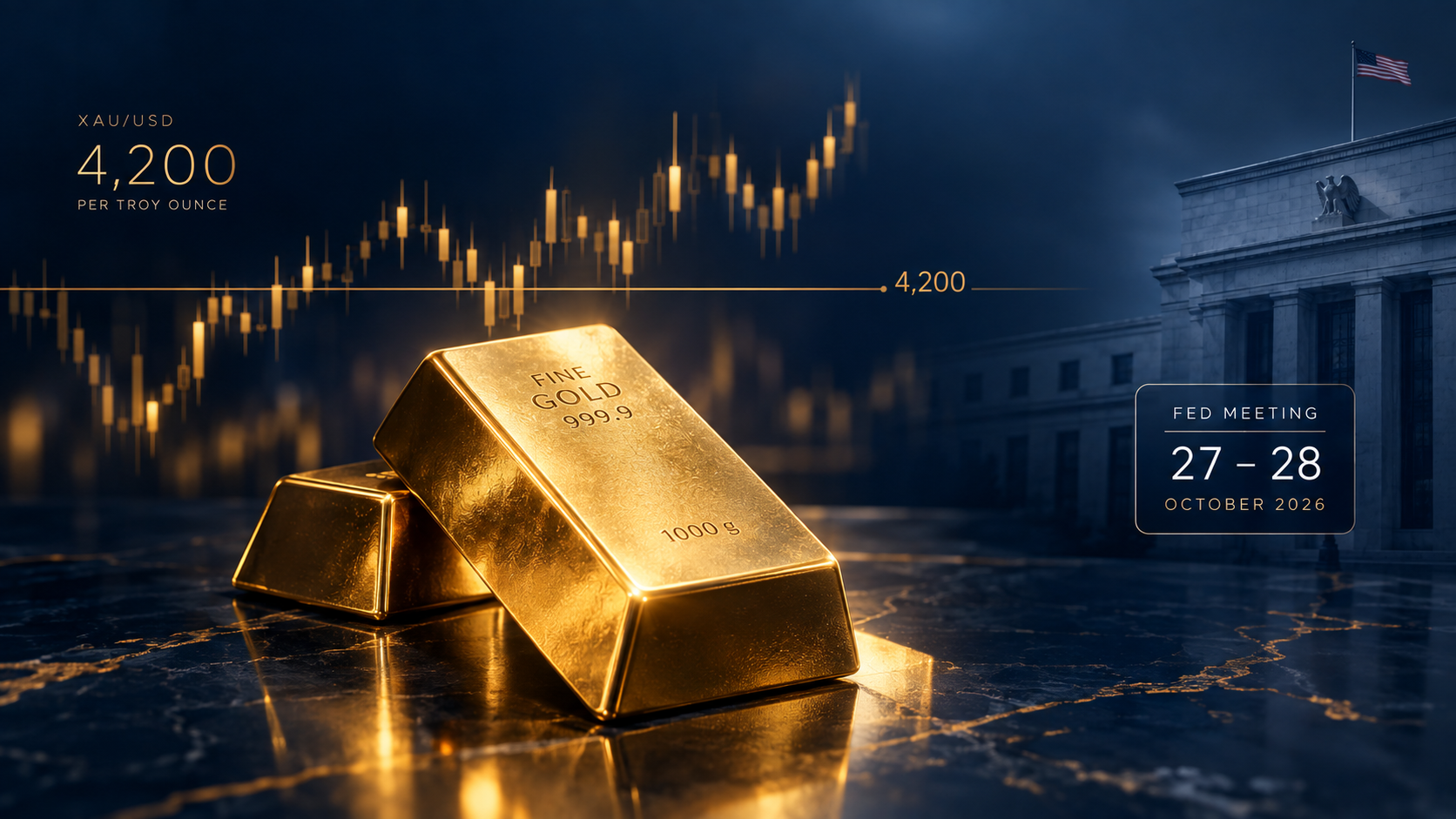
Gold Is Holding $4,200. The Next Big Move Depends on The Fed.
Gold is sitting at around $4,200 per troy ounce this week, and the market is waiting - everything hinges on what the US Federal Reserve decides on 27–28 October.
If you trade gold, forex, or commodities on a CFD platform, this is one of the most important months you will sit through in 2026. Here is what is happening, what it means, and what to watch.
What Is Gold Doing Right Now?
Gold opened October at $4,204.60 per troy ounce and has been trading in the $4,100 to $4,300 range. It is down about 3.9% from a month ago, but still up 8% compared to October last year.
To put that in perspective: gold hit record highs above $5,000 earlier in 2026 before pulling back. That pullback happened because the US Federal Reserve made it clear that interest rates were not coming down as fast as markets expected. Gold slipped, and it has been finding its feet since.
Right now, Gold is in a consolidation phase. That means it is neither crashing nor flying. It is waiting for new information, and that information arrives later this month.
Why Should Traders Care?
South Africa is one of the world’s largest gold producers. When the gold price moves, it does not just affect global markets. It affects South African mining shares, export revenue, and often the strength of the Rand (ZAR) itself.
When gold ran above $5,000 in January 2026, the rand pushed close to R16 to the dollar, its strongest level in years. When gold pulled back, that support faded. The two are not always in lockstep, but the relationship is real and South African traders have more reasons than most to pay attention to gold price movements.
If you are trading XAU/USD, USD/ZAR, or South African mining-linked instruments on a CFD platform, the gold market is part of your world whether you trade it directly or not.
What Is the Federal Reserve and Why Does It Move Gold?
The Federal Reserve, often called the Fed, is the central bank of the United States. It controls US interest rates. When rates are high, holding gold becomes less attractive because money sitting in a bank or in bonds earns a return. Gold earns nothing, so traders sell it. When rates fall, the opposite happens.
Right now, US rates sit at 3.75%–4.00%. According to CME Group data, there is a 62.9% chance the Fed holds rates exactly where they are at their 27–28 October meeting. Markets are not expecting a cut. Some are pricing in the possibility of another hike. That uncertainty is what is keeping gold rangebound. Traders are not willing to push the price higher until they know which direction the Fed is leaning.
What Do the Analysts Say?
Goldman Sachs projects gold will end 2026 at $4,650 per troy ounce. That is slightly lower than their earlier forecast, revised after the Fed took a more aggressive stance in September, but the bank maintains the long-term picture remains positive. JPMorgan’s year-end target sits at $4,500. Other institutions range from $4,000 on the cautious side to above $4,900 on the bullish end.
The reason most major banks still expect gold to finish higher is about who is buying and why. Central banks around the world are buying gold at rates not seen in modern history. Goldman Sachs estimates that central banks are purchasing an average of 50 tonnes of gold per month in 2026, roughly three times the rate seen before 2022. Countries are reducing their reliance on the US dollar in their reserves and adding gold instead. That is a structural shift, not a short-term trend, and it puts a floor under the gold price.
Key Dates to Watch in October
7–9 October: US Services data and FOMC meeting minutes are released. These give traders a clearer picture of where the Fed is thinking.
27–28 October: The Federal Open Market Committee (FOMC) meeting. The Fed announces its rate decision here. This is the single biggest event on the calendar for gold this month.
A surprise rate hike would likely push gold lower toward the $4,000–$4,100 range. A hold with a softer tone would support prices and could open up a move toward $4,400–$4,500 before year-end. A clear signal that cuts are coming would be the most bullish outcome for gold.
What Does This Mean If You Trade CFDs?
CFDs, or contracts for difference, let you take a position on gold’s price without buying physical gold. You can trade both directions. That matters in an environment like this one, where the market could move sharply up or down depending on a single announcement.
The $4,100 level has been holding as support. The $4,300–$4,350 area has capped most recent rallies. Traders watching XAU/USD right now are working within that range, with the FOMC meeting as the catalyst that either breaks the range or confirms it.
Position sizing and risk management matter most in periods like this. A rate decision can move gold by $100–$200 in hours.
If you are new to gold trading or want to understand how CFDs work before putting capital at risk, you can open an account with BOF Asset Management here.
The Bigger Picture
Gold’s short-term story belongs to the Fed. But the longer-term story belongs to something bigger: a slow but steady shift away from dollar-dominated global finance, with gold stepping in as the reserve asset of choice for governments that want independence from US monetary policy.
For South African traders, that shift matters. A world where gold holds structural demand at elevated levels is a world where South Africa’s commodity exports stay competitive, and where CFD traders on gold have real, ongoing opportunity to position.
October 27 is the date to mark. Until then, the range is the game.