
- For decades, energy markets have treated oil and gas as the ultimate strategic commodities of the Middle East.
- Recent developments around the Persian Gulf suggest another resource may increasingly shape geopolitical risk calculations: water.
- Two desalination facilities on opposite sides of the Gulf were recently caught in escalating regional tensions involving Iran, the United States and Israel.
- Bahrain reported that an Iranian drone damaged a desalination plant, while Iranian officials said a facility in southern Iran had been targeted the day before.
- Neither incident disrupted water supply, but the symbolism highlights a vulnerability that rarely appears in financial risk models.
The overlooked infrastructure risk
- The Gulf’s economic model relies on desalination to sustain urban life in one of the world’s most arid environments.
- Temperatures can exceed 50°C and permanent rivers are virtually nonexistent.
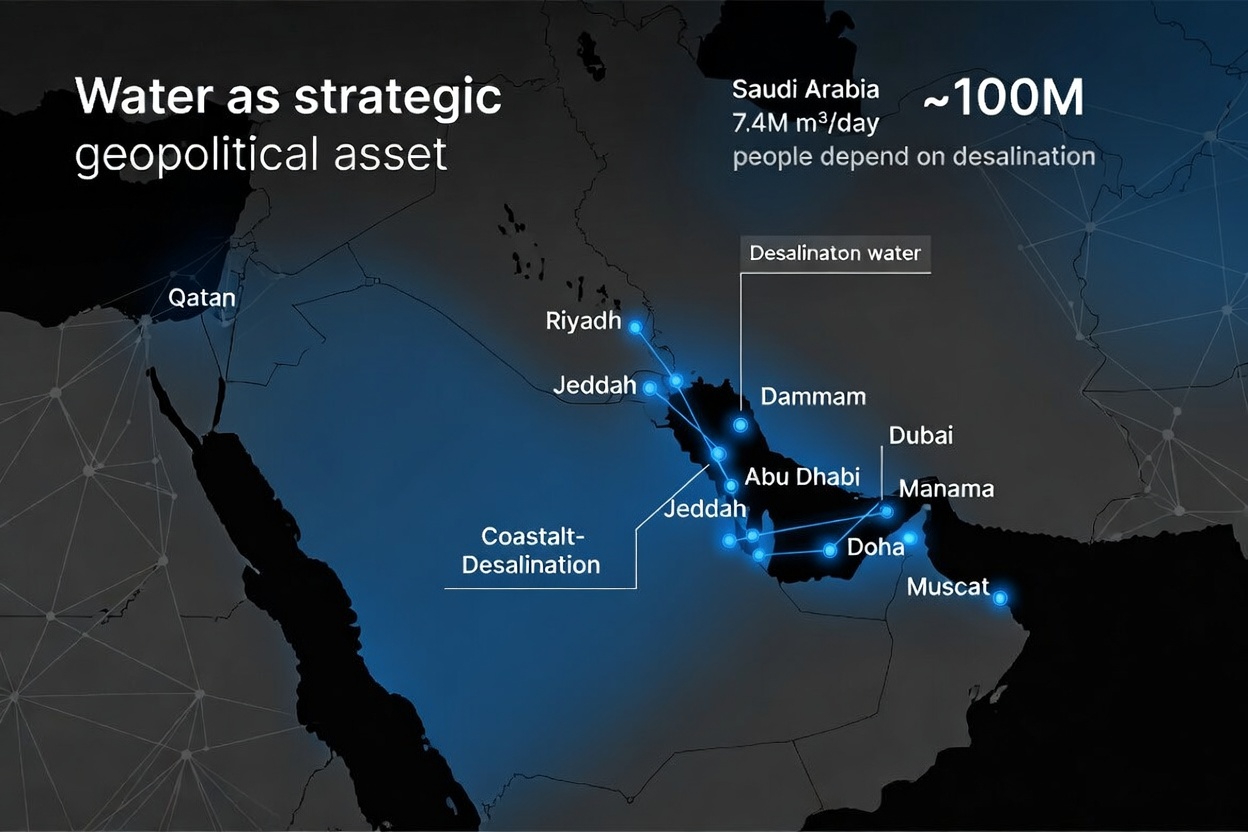
- Across Gulf Cooperation Council countries, roughly 100 million people depend on desalinated water.
- Saudi Arabia alone produces more than 7.4 million cubic meters of desalinated water per day, making it the largest producer globally.
- Unlike hydrocarbons, desalinated water relies on highly concentrated infrastructure.
- A small number of large industrial plants convert seawater into drinking water and distribute it through extensive pipeline networks.
- This concentration creates systemic risk because a limited number of facilities support entire metropolitan regions.
- For example, Riyadh receives most of its drinking water through pipelines stretching hundreds of kilometers from desalination plants along the Gulf coast.
Why this matters for markets
- Desalination plants are classified as civilian infrastructure and protected under international humanitarian law.
- However, modern conflicts increasingly target economic infrastructure capable of creating cascading disruptions.
- Airports, energy facilities, ports and refineries have all been targeted in recent regional confrontations.
- Water infrastructure now appears to be entering the same risk category.
- Commodity markets traditionally focus on assets with deep financial markets such as oil, natural gas, metals and agricultural products.
- Water rarely enters that conversation because it is usually managed through public utilities and state infrastructure.
- Yet geopolitically, water behaves like a strategic commodity because it is essential, non-substitutable and difficult to store at scale.
Limited buffers
- Unlike oil, most countries do not maintain large strategic reserves of potable water.
- Even where storage exists, it is limited.
- The United Arab Emirates maintains roughly 45 days of strategic water storage and operates multiple desalination plants for redundancy.
- In a crisis scenario, governments would likely prioritize drinking water while cutting non-essential uses such as irrigation, landscaping and certain industrial activities.
- However, the structural vulnerability remains.
- Population growth, climate change and rising temperatures are intensifying water scarcity across the Middle East and North Africa.
- According to the World Bank, regional per-capita water availability averages about 480 cubic meters annually, compared with a global average of 5,500 cubic meters.
The geoeconomic signal
- For investors, the lesson is less about immediate disruption and more about structural risk.
- Geopolitical conflict is increasingly intersecting with critical infrastructure that underpins modern economies.
- This includes energy systems, data networks, shipping routes and now water systems.
- The traditional hierarchy of strategic commodities may be shifting.
- Oil markets remain central to global energy security.
- But water — particularly in regions dependent on desalination — is emerging as a vulnerability with potentially greater societal impact.
The bottom line:
Water is not yet an investable commodity in the traditional financial sense. But recent events suggest it is rapidly becoming a geopolitical one.